
My column in OnlySky
Five lessons from the midterms
Democracy works, when we choose to use it.
18 Nov 2026
Despite the blowout of the 2026 midterms, we should not be sanguine. As Churchill said, this is not the end, not even the beginning of the end; but it is perhaps the end of the beginning. A certain political style of ignorance, incompetence and cruelty has finally been exposed. We can relax for a moment and feel good about our system of government, before the pressures of actually governing fragment us again, and consider the lessons from the midterm elections.
I think there are five main lessons.
Lesson 1: Democracy works
The columnist Ross Douthat made this point when voters in Hungary rejected the government of Viktor Orbán. Systems that allow the people a regular and open chance to change their governments are just better than those that do not. We didn’t need revolution or violence to check Donald Trump—mere voting did it. And remember, the people rejected Trump once before, in 2020. It was not their fault that the Democrats did not deliver change that bettered the lives of ordinary people.
This time, too, the voters have not embraced Democrats, only rejected overreach by Republicans. No more deporting everybody. No more trade wars with allies. No more foreign wars.
To make the midterm results last, Democrats will have to figure out simple and reasonable steps to improve the lives of ordinary people. I’m not impressed with the proposals I’m hearing. Since government cannot lower prices unilaterally, and should not, the only way to address affordability is to promote higher wages. Congress could do that by raising the federal minimum wage, abolishing the fiction of “managers” who don’t receive overtime making only $35,568 a year, punishing union busting and illegal company anti-organizing efforts. And a lot more.
Democrats, just give Americans a raise.
Lesson 2: The Constitution held
This may be the least appreciated lesson from the midterms. We will now end the Trump era just as free as when we began it. Trump’s threats against law firms, universities and political enemies certainly did a lot of harm and showed a lot of people to be cowards, but they basically failed.
The courts prevented Trump from interfering with the midterms. At least when the U.S. Supreme Court spoke, Trump complied. You may feel the Justices should have done more to limit Trump, but they did enough. The rule of law is still binding in America.
Lesson 3: Money isn’t everything
I’m not saying it is a good thing that Elon Musk spent $800 million total in 2024 and 2026 to elect Republicans. But massive Republican spending in the midterms apparently did not help them very much. Florida, for example, was an exception to the blue wave, but that was not because Republicans there had any special monetary advantage. What they had was a much better, and better organized, message.
The overestimation of the importance of money in politics is not a new idea. Trump was always outspent in his campaigns and yet overcame that. Maybe Democrats and liberals should stop worrying about campaign finance laws and start convincing people to support good ideas. Complaints about money by the left have been used as an excuse for political incompetence.
Lesson 4: You can talk to your neighbors
Although Democrats did have a turnout advantage, this was not just a turnout election. NBC News put it simply: “Millions of Americans who voted for President Donald Trump backed Democrats in Tuesday’s midterms.” I know people on the left who said that could not happen, that anyone who voted for Trump was a lost cause, an unrepentant racist, sexist and homophobe. Well, it turns out that plenty of decent people voted for Donald Trump, probably because they felt badly treated by an unfair system and wanted a chance for a better life. It turns out that people we disagree with might be worth talking to.
The midterms were an illustration of why countries that have free speech and a free press do not become dictatorships. The failures of the Trump administration were made plain and people talked about those failures. All that worry about social media, bots, and disinformation making policy discussion impossible proved false. So, maybe climate change denial and vaccine resistance could also be overcome through clear information and competent campaigns.
Lesson 5: Religion is not the enemy
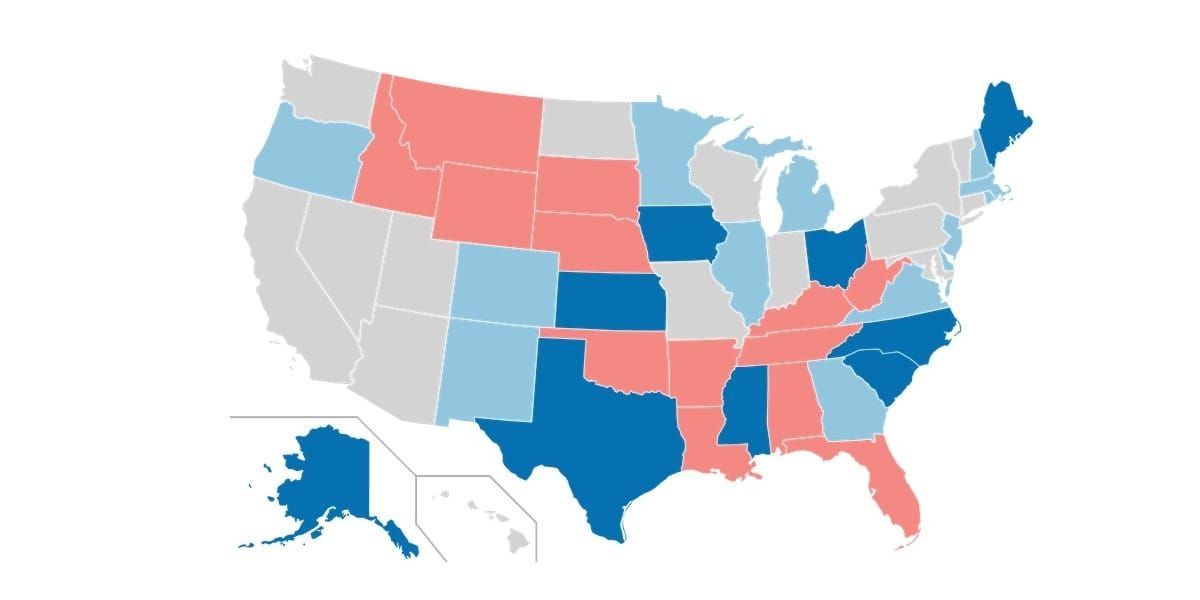
This may be the hardest lesson for secularists to swallow, but without the Senate victories by two self-identified Christians—seminarian James Talarico in Texas and Rev. Adam Hamilton in Kansas—the midterm election would not have been such a rout. And there were victories by other self-identified religious believers as well.
To govern nationally in a country where about 65% of the population still identifies as Christian, and in which there are millions of believers in other religions as well, the Democratic coalition has to be open and welcoming to people of faith. That welcome has to be more than just rhetorical and theoretical. It means that symbolic actions like prayers at presidential inaugurations and the prayer breakfast on the National Day of Prayer are here to stay for the foreseeable future.
Of course, secular voters are going to continue to oppose what they consider violations of the separation of church and state, like Ten Commandments displays in public schools and public funding of private religious schools. But we should be looking for religious allies in those fights too. The point is that a nationally governing coalition in America has to include religious voters. Politics is not the place for religion bashing.
Aside from these particular lessons, there is a greater message from the midterms. It has become fashionable to bemoan the end of liberal democracy. Autocrats claim it no longer works, that history has left it behind. The midterm results remind us that our system of government, and those of other democracies, represent the best system of government that human beings have ever invented. China and Russia could not as readily change course—violence would probably be necessary. And that violence would be unpredictable. Over time, no political system except a free democracy will respond to the will of the people in a peaceful and sustainable way.
We should be very proud of our system—even people whose preferred candidates lost. Our system of government is OK. We just need to be better at using it.

0 Comments