
My column today in OnlySky.
Disclosure: OnlySky’s publisher, Shawn Hardin, is a producer of HEATHENS. The author of this column was provided a screener of the film.
Ever since the Humanist Chaplain at Harvard, Greg Epstein, responded to the New Atheist wave in Good Without God in 2009, presenting a positive version of humanism without hostility to traditional religion, the question for secularists has been: since we reject religion, what do we believe?
Despite his book’s subtitle, “What a Billion Nonreligious People Do Believe,” Epstein did not present a study of what non-religious people actually believe. Rather, he was advocating an admirable and inspiring account of the philosophy of humanism. More like what non-believers could, and maybe should, believe.
In this regard, nothing much has changed since 2009. There are more of us nonbelievers. But we still don’t actually know what nonreligious Americans do believe, let alone nonreligious people in the rest of the world. Are we humanists? Materialists? Worshippers of the Force?
The other side of deconstruction
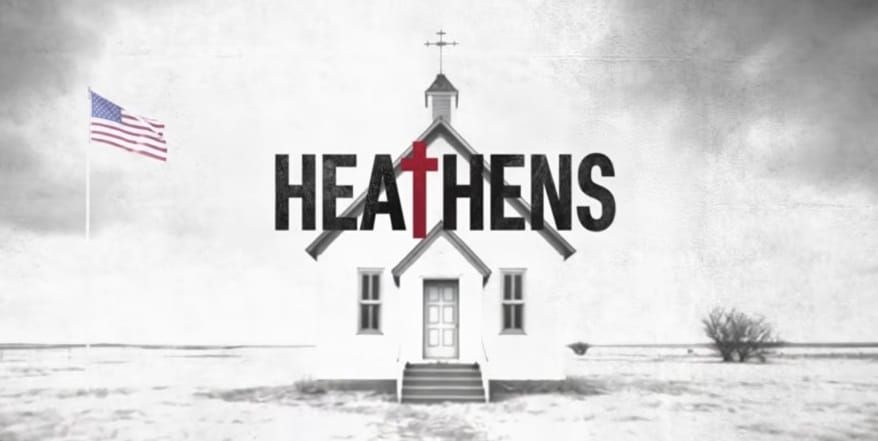
Now along comes a documentary, Heathens, produced by David Cowan and Shawn Hardin, the founder and publisher of OnlySky, that may help nonbelievers begin a serious conversation about what we should believe.
The film tells the story of five people who deconstruct their deep-seated religious beliefs, leave the church, and try to recover from religious trauma through introspection, ceremony, storytelling and, above all, music. Their names are Allen, Darante, Sarah, Nathlye and H.G. We watch these five people grapple with coming out as non-believers to their friends and families in a deeply religious culture; in the film’s vocabulary, they announce themselves for the first time as proud heathens.
None of the five is gay, transgender or non-binary. Prior to their deconversions, they had not committed actions that caused them to be cast out of their churches. Each was firmly and, at times, happily, embedded and welcomed in church and family life. But they have clearly been harmed by their religious experiences. The film wants to explore the negative effects of religious beliefs on ordinary people in ordinary circumstances and to contrast that with the positive possibilities of secular life.
While the film shows the viewer the dark side of Christianity in America, that is really not its main point. Yes, Christians can be racists. One of the five subjects, Darante, points out that he has yet to meet a racist who was not a believer. Yes, the Christianity that these five know does little or nothing to confront injustice in America. We see footage of Christian nationalists berating Jews and gays. We hear about people being cut off for believing or acting in certain ways. We understand the lyric, “No hate like Christian love.”
On the other hand, the one practicing Christian who appears in the film, Nathlye’s brother, is a sympathetic character. The film also points out that Christian belief, and the support of fellow believers, gives a young Darante the courage to confront his abusive and alcoholic mother, rather than continuing to enable her addiction. In other words, the film makes its point about religion without denigrating everything religious.
Theological trauma
The film’s interest is the harmful effects of religious belief on these five people. For example, as a young girl, Nathlye endured sexual abuse from a fellow church member. But the viewer is aware that that could happen in many American institutions, from churches to the Boy Scouts. The religious trauma that she suffers is not so much from the abuse itself, but the deeper, theological trauma that it led to: she was told that she should forgive her abuser because he had asked for forgiveness. And then her abuser was welcomed back into the community.
Similarly, Nathlye’s first religious memory is that of being told that her best friend would go to hell because the friend was a Roman Catholic. Several of the five complain that their early questioning of religious dogma was rebuffed rather than encouraged. H.G., who had been a career church musician, believed that the rare disease that prematurely ended his musical career was a punishment sent by God for the sin of using his music to glorify himself instead of God. And they all report the constant fear of hell. The group repeatedly sings, “I can’t win when everything’s a sin.” These are the religious teachings that have kept these five people locked up, frozen, unhappy and unfulfilled for many years.
Religious believers who watch the documentary may object that the experiences of the five subjects do not reflect the true nature of the Christian community. But these are the experiences that these real life people had and the actual harms they suffered from religious teachings.
What the film tries to do is contrast these destructive beliefs of Christianity with something healthy and liberating. But the viewer soon comes to see that these five people are not able to articulate what they now believe. At least not expressly. They only really know what they no longer believe. They don’t believe in a personal creator god controlling events. They don’t believe in miracles. For this reason, the film can only hint at where they are now in their beliefs and in what direction they might move in the future.
Original sin or human goodness?
These hints about a religious worldview and its contrast with a secular belief system unfold through several themes. One of these is the assertion of the goodness of people versus what might be called the doctrine of original sin—or, more simply, the venality of people. At one point in the film, an older man complains that he was taught in church, “I am a piece of shit, but God loves me anyway.” At various points, the five subjects of the film echo this description of life in the church. But never did the “God loves me anyway” part appear to come through. Sarah describes church teaching as “I’m inherently bad.” Period.
In contrast to this religious teaching, their current view, what we are to take as the secular view, is that people are generally good. Allen points out that despite leaving religion, he does not “go around raping and pillaging.” As Sarah puts it, “Why can’t I just be a good person who happens not to be religious?” Sarah is also here expressing the belief that this goodness in human beings can be achieved without much difficulty, certainly without the dogmas of the church. Human beings can conduct themselves in a good way without all that.
This secular endorsement of the basic goodness of people reflects a fundamental difference from various religious traditions and from Christianity in particular. The older man’s comment may not mean much to people who are basically satisfied with themselves, but it explains why Christian recovery programs can be so effective. Addicts who seek treatment often feel that they have failed as people. For them, the notion that God loves them anyway may be a first step to recovery. Inevitably, the film raises the question of which perspective on human nature is more realistic.
“I choose me”
These differing views of human nature are related to another theme in the film’s presentation of secular belief—the restrictiveness of religious life versus the open freedom of secular life. The subjects of the film express this contrast musically, singing, “I can’t win if everything’s a sin.”
This secular freedom may seem fine if you believe that people are basically good. The five subjects are fairly conventional in their lives. On the other hand, maybe the world would be a better place if more people—such as rapaciously greedy billionaires, sexual and domestic abusers, or apologists for war and violence—had maintained a stronger sense of sin: a belief that certain acts are wrong whether they are illegal or not. Again, the film leaves us to ponder this.
Both these themes—human nature and sin—merge in what is probably the major commitment of the film in terms of secular thought: the primacy of the individual. The musical expression of this theme is the lyric, “I choose me.” This primacy is presented in the film in pointed contrast to the church, where one is taught “to put yourself last.” The latter is certainly orthodox Christian dogma, in fact the heart of Christian practice from the beginning. Jesus is described by Paul as emptying himself to become a servant to others, even to death.
The question becomes whether choosing oneself is a preferable path. Do we lead happier lives as self-sufficient individuals, or do we have an inherent need to belong to something greater than ourselves, whether or not that cause is religious? The film offers no simple answer to that, although its setting at a retreat run by the nonprofit Recovering from Religion suggests that we all benefit from belonging to a community that encourages and supports us.
The overall worldview that the five subjects appear to believe underlies and supports a non-believing stance is a general and easy-going materialism. Religious stories about reality are referred to as a “fantasy.” In contrast, Allen describes secular people as living in the “real.”
Clearly, secular belief includes a rejection of anything like a creator god who controls the natural processes of the universe and produces miracles. It is not so clear that a secular stance also precludes the commitment of Dr. Martin Luther King, Jr., that the “arc of the moral universe, though long, bends toward justice.” That commitment expresses a deep faith in the future, but of course does not include any reference to miracles. Whether King’s commitment was in the real is a matter of judgment about history. It is a question, as the theologian Bernard Lonergan put it, about whether “the universe is on our side.’
But all of these considerations about secular belief remain preliminary in the film. The subjects of the film are, after all, just getting started. All of them feel a new responsibility to find their genuine centers and, as Allen puts it, try to be “the best possible version” of themselves. Unlike Greg Epstein, the film does not claim to describe secular life in anything like final terms. Instead, it illustrates one moment in the journey of these five people out of religion and toward something more promising for them. In that way, they are like most secular people. Most of us just know that we are not religious. The film presses us to go beyond that and try to find our own answer to the question: what do we believe?




0 Comments