
My column in the Post-Gazette.
Bruce Ledewitz: Fairness and good finances require a property tax assessment
Special to the Post-Gazette
May 19, 2025
4:30 AM
Given the predominance in registration, whoever wins tomorrow’s Democratic Party Primary — whether current Mayor Ed Gainey or challenger Corey O’Connor—is likely to be elected Mayor of Pittsburgh in November.
That next mayor will face a looming fiscal crisis because tax revenues are declining. Last year, tax revenue fell short of budgeted estimates by tens of millions of dollars.
Fortunately, a major part of that decline — falling property values in downtown Pittsburgh — has a partial solution: a property tax reassessment for the City and for Allegheny County.
Decline and loss
The decline in property values in downtown is not unique to Pittsburgh. Office building prices have fallen 52% on average in downtown business districts in America since the pandemic. Companies do not need as much office space when many workers are remote at least some of the time.
Though this phenomenon is no local leader’s fault, the consequences for Pittsburgh tax revenue are serious. Pittsburgh receives 23% of its revenue from property taxes. A quarter of that sum comes from downtown property. This lost revenue must be made up or ruinous cuts in city services loom.
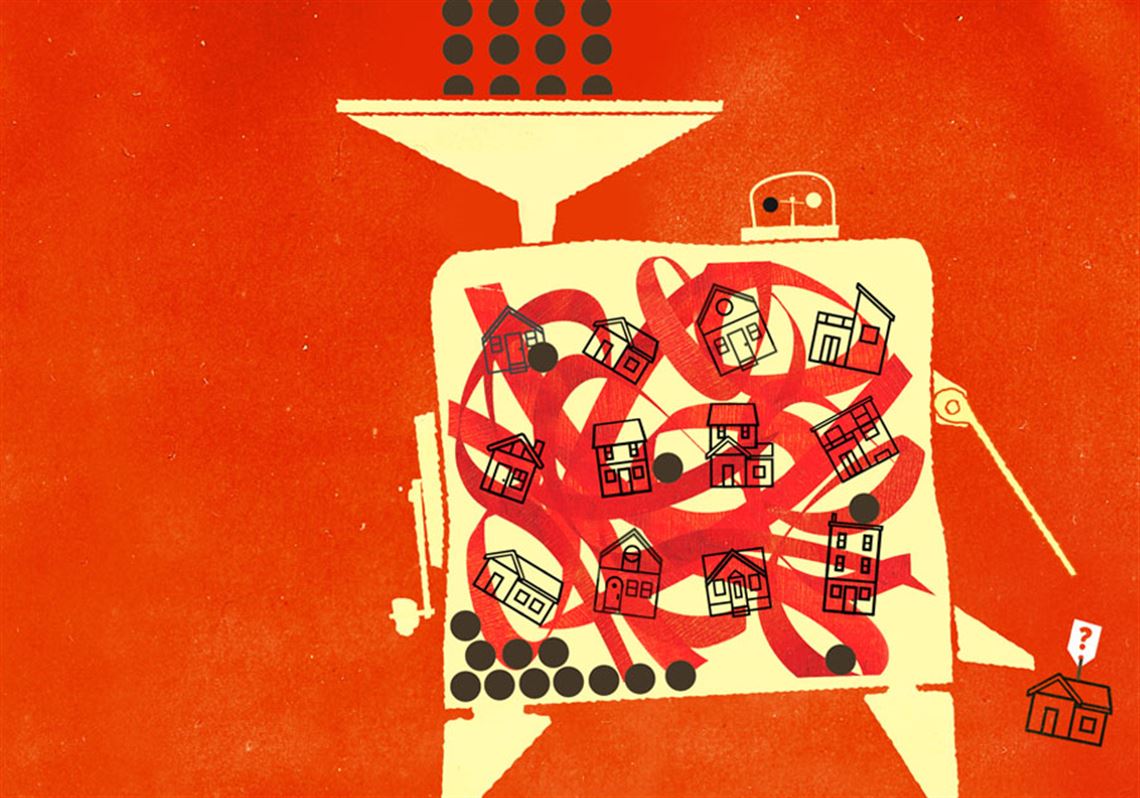
But this crisis is partly the result of the way the property tax is collected. Property values are not falling in all parts of the City. The value of commercial property is holding up outside downtown, both here and in other American cities. In addition, residential property values in the city are actually rising.
In theory, a property tax can smoothly accommodate changes in the property market. Tax revenue goes down in areas in which property values fall and goes up in areas in which they rise. Since a property tax applies equally to all property and all neighborhoods, overall tax revenue can remain stable or decline only to a small extent.
Market changes like this are common.
The reason for the apparent crisis in Pittsburgh tax revenue is simply that, under Pennsylvania property tax law, losses in property value can be immediately recorded, and tax burdens reduced, whereas increases in property value are usually not recorded until a reassessment.
The way this works, and the way it is happening right now in downtown Pittsburgh, is that large downtown property owners can appeal their property tax assessments when the value of office buildings goes down. In recent years this has led to a $600 million reduction in property tax values downtown.
Conversely, taxing authorities are precluded by law from attempting to increase property assessments in areas with rising values, with some limited exceptions, like major renovations.
Stable and balanced
If there were a general property reassessment, both the losses and gains would be reflected and a more stable property market would emerge. This would at least balance the tax losses the city is currently experiencing.
A property reassessment would not mean that city residents are subsidizing property losses downtown. It would simply mean that all property owners are paying their fair share.
Allegheny County does not regularly conduct reassessments. The last one was in 2012, by order of the Pennsylvania Supreme Court. This failure to reassess does not matter much when all property is increasing in value to more or less the same extent. That often happens.
When all property values are rising, reassessments do not change property tax bills very much, if at all. Since Pennsylvania law prohibits a reassessment from becoming a hidden tax increase, most people’s tax bills are unaffected. That is why, though the last property tax reassessment was widely dreaded, tax bills did not change very much for most people.
But a failure to reassess can be catastrophic when, as now, property values in one area are in decline while values are rising elsewhere.
The failure to reassess in that case is not only economically harmful for the city, it is grossly unfair. For example, small business properties downtown have also seen declines in value. But those owners mostly lack the legal resources to challenge their assessments. Those property owners are paying more than their fair share of the city tax bill.
Meanwhile, commercial property owners outside the downtown, and property owners in affluent city neighborhoods, where property values have increased, are paying too little.
No one likes property taxes. They go up with property values irrespective of the income of the property owner. This can force some people to sell their homes when their neighborhoods gentrify.
A crisis and a fix
But as long as Pennsylvania relies on property taxes, they have to be equally applied to all. This is not only required by the Pennsylvania Constitution but by common sense. Businesses and individuals benefit from increases in property values whether they sell or not. They should pay a property tax in line with the actual value of their property.
The failure to reassess when market conditions change is both unlawful and foolhardy. It makes a bad situation that is no one’s fault a lot worse.
Pittsburgh does face a fiscal challenge. The next mayor is going to have to make some hard choices. But part of the crisis is of our own making and can be addressed through a property reassessment.
Bruce Ledewitz is a professor of law at the Thomas R. Kline School of Law of Duquesne University. He writes every other Monday. The views expressed do not represent those of Duquesne University. His previous article was “A non-believer explains why Catholic conservatives never understood Pope Francis.”
First Published: May 19, 2025, 4:30 a.m.


0 Comments