
My column today in the Pittsburgh Post-Gazette.
Bruce Ledewitz: Our politics is a world of unreason
Insight
Apr 12, 2026
We live in an age of political unreason. Unless we are learn to think more reasonably, especially rejecting our own side’s partisan lies, America will never get better.
I write as a lifelong Democrat, raised in the Jewish tradition, a Pittsburgher for over four decades and a just retired law school professor. But I insist the problem is bipartisan.
On the right, Donald Trump’s absurd lies — about the war in Iraq, illegal immigrant voting, and climate change and much else — are repeated as true. After Trump was elected in 2016, Time Magazine asked, “Is Truth Dead?” In the last 10 years, the president has done his best to make the answer “yes.”
But unreason abounds on the left as well. During the pandemic, discussion of the virus’s possible origin in a lab in China was suppressed, as was any acknowledgment that the virus was mainly deadly for older people and was mutating into a less lethal form. Challenges to the shutdown orthodoxy were repressed.
Today the left refuses to acknowledge the obvious inappropriateness of boys competing against girls in high school sports and shouts down reasonable debate about balancing trans rights and the rights of women.
And no one in American public life, right or left, talks about the monstrous national debt.
How does one do politics in such a time?
Inevitable decline
Fortunately, a Canadian Catholic theologian, Bernard Lonergan, who died in 1984, left suggestions for the answer.
As befits a Christian thinker, he regarded creation as basically good, including human beings. Humans have a natural desire to try to understand how things are, a desire felt in all times and cultures. This human desire to understand reality leads to increases in knowledge, moral and human as well as scientific, and delivers progress.
However, progress is neither automatic nor continuous. Periods of decline are inevitable. Human beings have their flaws. All human beings can be inattentive, obtuse, shortsighted, unreasonable and irresponsible. These tendencies are made worse by a world that often rewards just such flaws.
Human beings also have biases, which lead them to reject reason. Lonergan identified several sources of bias, which all center around the human tendency to privilege our personal and group interests. We favor ourselves and our group and are hostile to others in what we think we see in the world.
Our biases lead to false judgments and inauthentic actions, which Lonergan calls sin. The effects of sin are self-reinforcing.
When individual human beings express these biases, the rational responses of the surrounding group usually reins them in. General decline occurs when group bias reinforces individual bias rather than correcting it.
That is our situation in America today, which Lonergan would label a longer cycle of decline. In such a period, the society as a whole ignores the need for long-term solutions to social problems and drops the prevailing norms of truth and standards of value. The culture becomes permeated by nihilism.
Inevitable progress
The good news is that decline does not last forever. We can work to reverse it.
For Lonergan, the ultimate source of that good news is God, who acts through all human beings, whether they believe in him or not. The human desire for truth reflects God’s love and is given to everyone, although not everyone responds to it.
He believed the universe reflects God’s grace and the ultimately redemptive community is the church. But he did not insist that religious conversion was necessary to arresting decline.
Lonergan thought that the remedies for decline were both personal and social.
In personal terms, each of us is called upon to adopt a higher vantage point. That means our thinking must eschew our own interests and desires. We must think of the good of all and be open to the reality of meaning and value that is independent of our own viewpoints.
A call to think
Lonergan did not criticize efforts to elect particular candidates to political office. But to the extent that we apply double standards that favor our side compared to criticisms of our opponents, we reinforce the bias that leads to decline. Doing politics that way — the way it is most often done today — inevitably fails to arrest decline.
At all times, but particularly in an age of decline, we must think broadly, calmly and clearly, addressing issues with clarity. This is not a program of electoral quietism, in which we sit by while our institutions are undermined. It is a call to rationality rather than emotion, to trust in thought as well as politics.
This is how we must act as individuals. But adopting a higher vantage point as an individual is not enough to reverse decline. It is even more important that we join with others to create communities of clear thinking.
Lonergan called such a group a “cosmopolis.” Here, he was essentially anti-political. A cosmopolis is not a political party and does not offer a program of reform. Its role is to exemplify rationality in all the different areas of human endeavor.
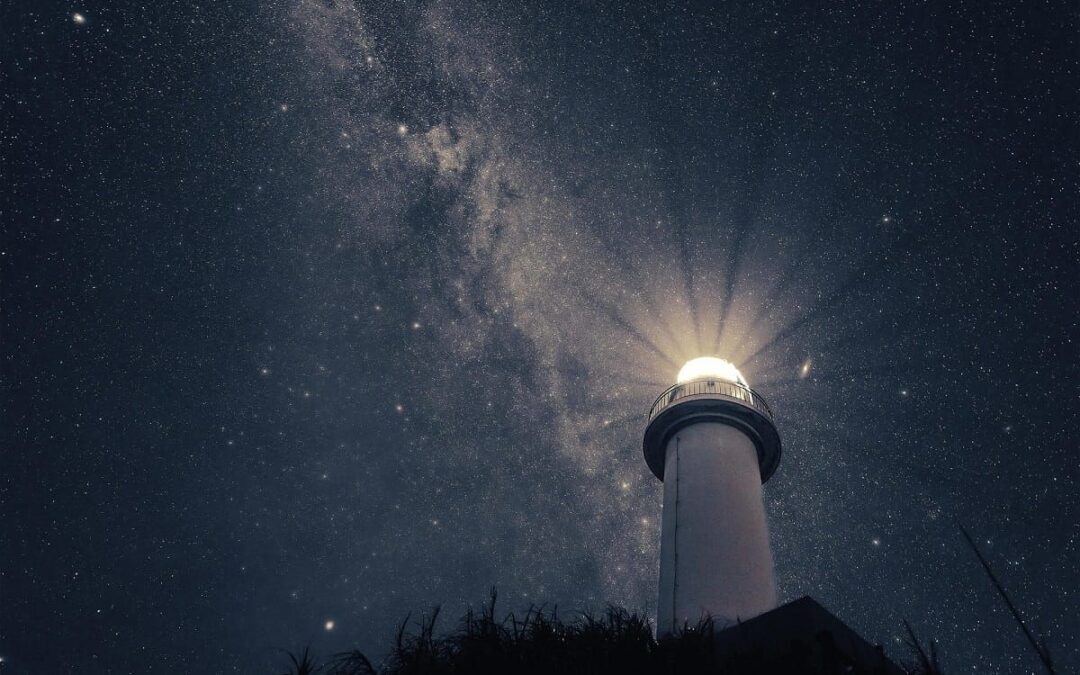
In the midst of our political chaos, think of cosmopolis as the Artemis II moon mission.
Each of us participates in groups where calm and clear thought goes on. This happens in educational institutions in particular, but it goes on in all human communities. All such groups are instances of the healing that arrests decline.
A universe on our side
Lonergan believed that our efforts would ultimately succeed because, as he put it for the benefit of non-religious people, the universe is on our side. As a Catholic theologian, he referred to this process as supernatural, but he was not pointing to miracles.
He meant that the universe is naturally generous. Emergence, a process in which outputs exceed what could be expected from the inputs that go into it, is an example of that cosmic generosity. Life arose through emergence as did human consciousness.
Because the universe is on our side, our efforts of renewal, although seemingly isolated, small and inconsequential, have large consequences in arresting decline. As a friend puts it, we are each a tiny rivulet that joins a stream that eventually becomes a river.
For this reason, all of us, religious and secular alike, can play our part in the renewal of public life by being as rational as we can, overcoming our flaws, joining with others and fighting our biases. Lonergan assures us that this renewal is certainly coming.
Bruce Ledewitz, a contributing writer for the Post-Gazette’s editorial page, is professor of law emeritus at the Thomas R. Kline School of Law of Duquesne University. He writes every other Monday. The views expressed do not represent those of Duquesne University. His previous article was “The 2028 presidential election is the last chance to Save Social Security.”
First Published: April 12, 2026, 4:30 a.m.


0 Comments