
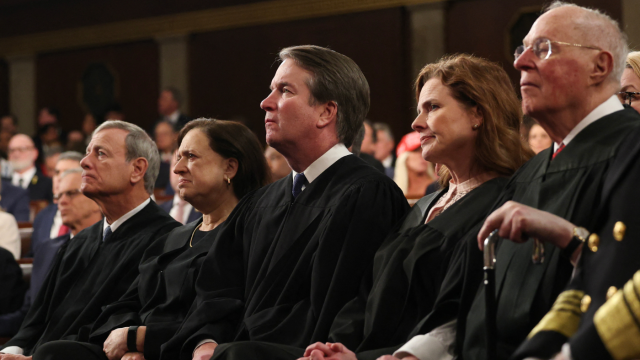
My column today in The Hill. You can access it here.
The U.S. Supreme Court is fast redeeming its reputation and, in the process, is reinforcing the rule of law.
The justices appear poised to protect the independence of the Federal Reserve and restrict at least some of President Trump’s tariffs. And since the Supreme Court has not reversed any of the lower courts’ decisions blocking Trump’s birthright citizenship order, the consensus among many law professors is that it may maintain the longstanding interpretation of the 14th Amendment.
Significantly, Trump seems content to follow whatever the court decides.
The court has handed Trump many victories, but it is now the only national institution with the prestige, power and will to stand up to him. This is the wonder of judicial review — our most enduring inheritance from the Constitution.
This reminder, however, is also a little mystifying. Americans do not know how judicial review of government actions for constitutionality works. The justices have spent years cultivating the false image of themselves as mere “umpires” calling balls and strikes. They claim they just follow the law.
For the conservative majority — Clarence Thomas, Samuel Alito, Neil Gorsuch, Brett Kavanaugh, Amy Coney Barrett and, sometimes, Chief Justice John Roberts, this narrative of just following the law includes a pledge of fidelity to originalism. That is the theory that the text of the Constitution should be interpreted according to what it meant at the time it was adopted. According to this approach, if you want to know whether Americans have a right to carry firearms, you ask whether they had such a right when the Second Amendment was adopted.
In a recent book, “Listening to the Law,” Justice Barrett has been banging the drum of originalism as the only neutral — that is, proper — way to interpret the Constitution. Barrett believes that any other approach to interpretation would mean that the personal preferences of judges control the meaning of the Constitution, which would be undemocratic.
However, all this talk by the justices is just a lot of hot air. The justices are not originalists and never have been. Instead, they practice common law constitutionalism. That is to say, they interpret the Constitution by means of all of the techniques of the common law, including text, history, structure and, above all, the justices’ conception of the common good. The values of the justices matter — a lot.
The court’s reliance on common law constitutionalism was on public display in 2024 in two important cases that outraged many Americans. In the midst of the presidential campaign, the justices had a hand in deciding the election.
In the Colorado ballot case, the court unanimously restored Trump to the ballot, after the State Supreme Court had removed him on the grounds that he had participated in an insurrection. The Insurrection Clause of the 14th Amendment bars insurrectionists from holding any public office. The Supreme Court held that the states cannot enforce this ban with regard to federal offices without congressional permission.
In Trump’s federal election interference case, the conservative majority erected a high wall of presidential immunity, barring, as a practical matter, criminal prosecution of former presidents for acts in office. If either case had gone the other way, Trump might well not have become president.
It is clear beyond dispute that neither of these decisions followed originalism. State courts routinely enforce the 14th Amendment, whether Congress authorizes them to do so or not. And both text and history of the Constitution show pretty clearly that there was to be little or no presidential immunity from criminal prosecution.
Critics noted that these very important decisions departed from originalism, despite the formal commitments of the conservative justices. The critics had a ready explanation: The justices were partisan hacks doing the bidding of the Republican Party.
But this was also clearly wrong. For one thing, the key ruling in the ballot case that states could not enforce the Insurrection Clause was unanimous, including liberal Justices Sonia Sotomayor, Elena Kagan and Ketanji Jackson. For another, because of Trump’s threats, presidential immunity is now protecting former presidents Joe Biden and Barack Obama.
There was a simpler explanation: The justices were not abandoning originalism. Rather, they almost never follow it. The justices were just engaging in the common law technique of prudential judging. All of the justices were worried about the effect of these decisions on the future of constitutional democracy and on the perceived role of the court in the presidential campaign. They may have gotten the results wrong, but they were doing what they thought was best for the country.
Why do the justices pretend they follow originalism? Why don’t they admit they do what’s best? The probable reason is that our culture is skeptical about the objectivity of any value, including justice.
We assume that judicial judgments are just personal opinions. The justices may even wish their values did not matter. But the law has always involved judgment. To fully restore the rule of law, the American people need to understand that the sense of justice has always been, and remains, at the heart of law.




0 Comments