
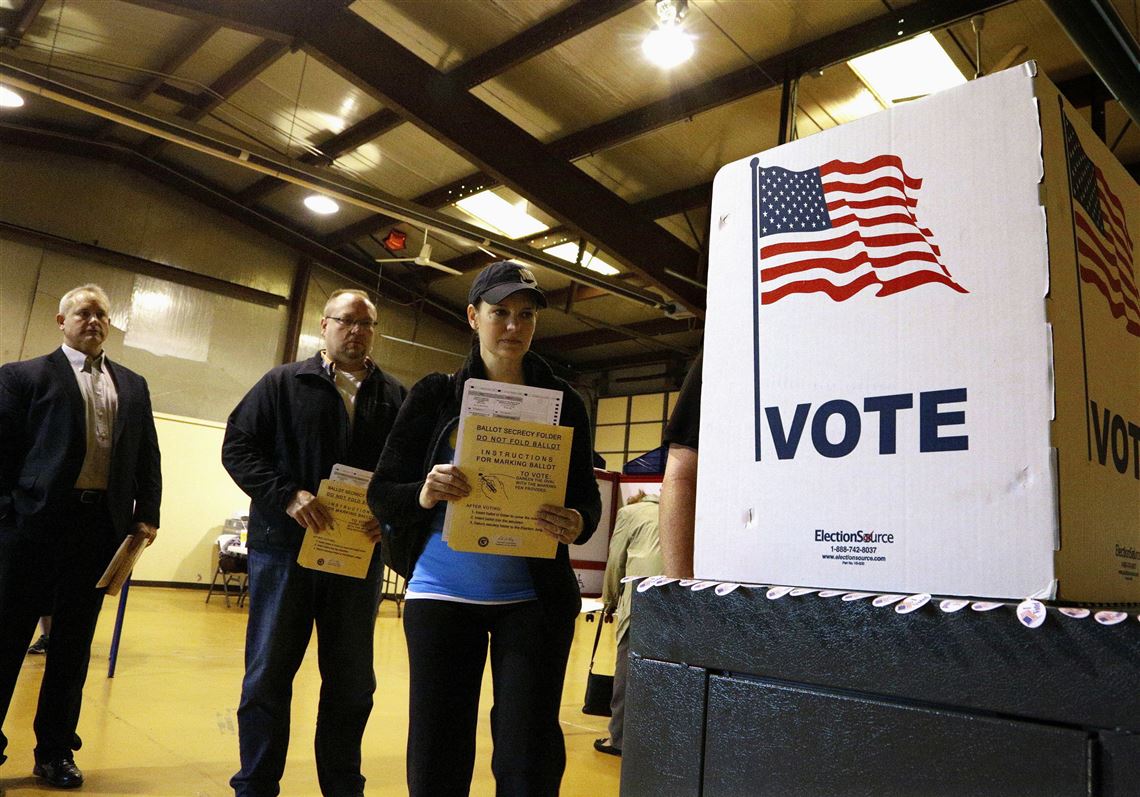
On Tuesday, Nov. 3, 2026, America will hold midterm elections for Congress. These elections will determine political control of each House of Congress. At the same time, state elections will take place that will determine political control of local governments and state governments across the country.
In Pennsylvania, local government elections and judicial elections are held in odd numbered years. This system is meant to keep judicial elections insulated from statewide political issues. So, in 2026, Pennsylvanians will vote for Governor and for representatives to the two Houses of the General Assembly.
Gov. Josh Shapiro is running as a Democrat for a second term against Republican Stacy Garrity and Libertarian Party candidate Ken Krawchuk. Shapiro is well ahead in the polls. If he is reelected he will be term limited by Art. IV, Section 3 of the Pennsylvania Constitution from running again for Governor in 2030. The office of Lt. Gov. will also be voted on in November, but that office runs with the candidate for Governor as a single ballot. Shapiro is widely rumored to be interested in higher federal office in 2028—either running for President or being considered again for Vice President, as he was in 2024.
Nationally, all of the 435 seats in the U.S. House of Representatives are subject to election in 2026, which has a two year term. Thirty five Senate seats are on the ballot, which is two more than normal because of special elections in Ohio and Florida. In Ohio, the election will replace J.D. Vance, who was elected Vice President in 2024 and in Florida, Marco Rubio resigned to become Secretary of State. The Senate is currently divided between 53 Republicans and 47 Democrats. Of the 35 Senate seats in play, 22 are currently held by Republicans. Democrats need a net gain of four seats to take control of the Senate. Democrats are currently favored to take majority control of the House and Republicans are narrowly expected to retain majority control of the Senate.
As of the end of August, the Cook Political Report rates the Senate races as follows:
Current Cook Political Report Breakdown (35 Seats Total)
- Toss-Up (6 seats): Highly competitive races where neither party has an advantage.
- Lean Democrat (3 seats): Races that favor Democrats, but remain competitive.
- Likely Democrat (1 seat): Races where Democrats are favored to win.
- Solid Democrat (9 seats): Safe seats heavily favored to stay Democratic.
- Lean Republican (0 seats): Currently no seats in this category.
- Likely Republican (2 seats): Races where Republicans are favored to win.
- Solid Republican (14 seats): Safe seats heavily favored to stay Republican. [1]
The three lean Democratic states are Georgia, Michigan and New Hampshire. The six toss up states are Iowa, Texas, which had been rated as lean Republican, Alaska, Maine, Ohio and North Carolina. The outcomes in those nine states will determine control of the Senate.
But these forecasts assume that the midterm elections will be held as normal elections—a matter about which there is some doubt because of the possibility of federal interference with voting. President Donald Trump claims that thousands of non-citizens, and other persons ineligible to vote, are currently registered to vote across the country and pose a threat to rig the coming elections for Democrats. Trump has vowed to prevent this from happening.
Trump’s claims are not true but he keeps repeating them. In a July prime-time talk to the American people, Trump claimed that a Department of Homeland Security investigation “identified approximately 278,000 noncitizens who are registered to vote in federal elections.” Trump also cited a recent Census Bureau “beginning analysis” claiming that 24,000 noncitizens voted illegally in the 2020 presidential election that Trump lost to Joe Biden.
The clearest evidence that these claims are nonsense are that no individuals have been identified and no prosecutions have been brought. Each one of those purported 24,000 non-citizen voters is presumably guilty of a crime and is subject to deportation. It would be very easy for computer software to identify who these people are.
Mistakes do happen. New Jersey recently found that 6,600 noncitizens were improperly registered through its motor vehicle system in 2023 and 2024, apparently through no fault of their own, and around 400 of them actually voted. On Friday, Aug. 28, the U.S. attorney’s office in Los Angeles arrested a Honduran national on charges that he fraudulently registered to vote. In August, a man was arrested on charges he voted for President in two states—Alaska and Pennsylvania—in 2024. That man was a registered Republican.
But mistakes are not systematic fraud. And even Trump’s false claims have nothing particularly to do with mail-in voting.
In March, based on these false claims of illegal voting, Trump issued an executive order purporting to authorize the U.S. Postal Service (USPS) to restrict or refuse the delivery of mail-in and absentee ballots in states that do not comply with federal verification guidelines. In late August, the Post Office issued guidelines on carrying out Trump’s directive. The government had been enjoined by a federal court from carrying out Trump’s order, but on Aug. 24, by an unsigned 6-3 order, the U.S. Supreme Court vacated the injunction on the basis that that the lower court lacked jurisdiction to issue it because the states had not been harmed by the government complying with the order. Essentially, all the government was doing was internally compiling voter lists, which, by itself, has nothing to do with the States. Therefore the states lacked standing to sue over the order. (Trump v. California).
The President has no authority to control how elections to national office are run. The Constitution in Art. I, Section 4 places the authority to determine the “Times, Places and Manner of holding Elections for Senators and Representatives” in the state legislatures, subject to oversight by Congress. Nor does the Post Office have the authority to refuse to deliver ballots the states deem lawful. Thus, Trump’s Executive Order seems to me clearly unlawful. The Court majority did not decide on the order’s legality but did use the worrying and odd phrase, “time will tell.”
Many legal observers criticized the Court majority as did the three-Justice liberal minority, for allowing the order to go forward at all, fearing that even the possibility of enforcing the order will suppress Democratic Party voting. Some even worry that the Court will somehow uphold the order and allow the Post Office to pick and choose which ballots to deliver. I don’t share these worries. I believe the majority was practicing what Yale Law Professor Alexander Bickel called the “passive virtues” of not rendering controversial decisions unnecessarily. Ballots are going out in the mail right now and it is probably too late for the federal government to do anything at all about mail-in voting in the midterm elections.
The other federal threat to voting in the midterm elections concerns in-person voting. Again based on his false narrative of threatened fraudulent voting, Trump has made various threats to send Dept. of Justice observers or immigration agents to the polls to prevent illegal voting. According to The Associated Press, Bobby Charles, Maine’s Republican nominee for governor, recently told a crowd of supporters that he would ask Tom Homan, the White House official in charge of border security, to send U.S. Marshals and Immigration and Customs Enforcement agents to polling places in the state for this fall’s midterm elections. Other Republicans are likely to do the same.
Even assuming that these calls are being made in good faith and are not just pretenses to suppress Democratic Party voters from going to the polls, it is not clear how a federal presence at the polls would address illegal voting. During the Civil Rights Era, the Justice Dept. did send poll watchers to polling places to watch for discrimination against black voters, particularly in the South. But by 2016, that number had declined to nearly zero.
In the case of voting by non-citizens, however, observers make no sense. Either a voter’s name is on the voting rolls or it isn’t. If it is, how could a federal observer know whether the person is eligible to vote or not? If the federal government already has names of persons who are on state voting lists but are ineligible to vote, those persons should be notified ahead of the election—and in some cases arrested. Actually going to the polls has nothing to do with it.
On the other hand, if the federal government merely suspects that someone is ineligible to vote, it would presumably be illegal for a federal observer to do anything at the polls. That would interfere with the fundamental right to vote. Clearly, an ICE agent could not challenge any person voting who appears to speak Spanish to produce proof of citizenship. If that kind of thing began to happen, I assume the state courts would quickly put a stop to it. Federal law is supreme but there would not appear to be any valid federal interest present to balance against the right to vote.
All of this suggests to many people that Republicans simply want to intimidate legitimate voters from voting. If so, I’m confident this scheme will not work. Ultimately, the American people are going to decide whether we are still a free people in the usual way that our rights are protected—by voting.




0 Comments