
My column today at OnlySky.
OnlySky
America’s 250th: Looking backward and forward
America has been divided for 250 years. If we make it to 500, will we be still having the same arguments or will we have outgrown them?
31 Jul 2026
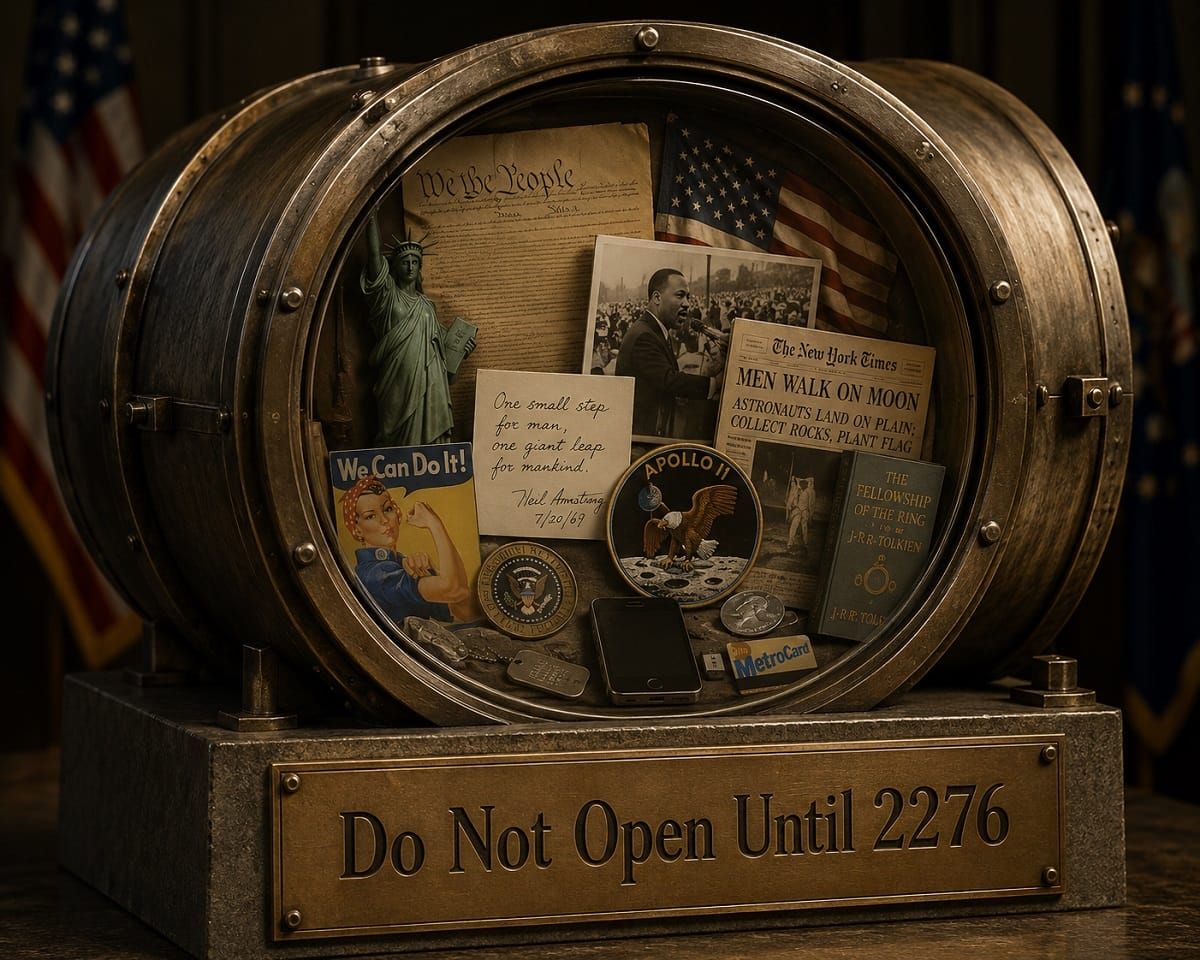
Concept art — AI-generated
Now that the firework smoke has cleared, we can begin to evaluate America’s 250th birthday. The event can be approached in two ways—what it showed about where America came from and what it suggested concerning where America is headed: looking backward and looking forward.
The looking backward aspect is complicated by the presence of two expressly and organizationally competing narratives about America’s past: America 250 and Freedom 250. America 250 was the official, bipartisan, congressionally chartered committee established in 2016 to plan national, nonpartisan historical and educational events across the country. Freedom 250 was a public-private partnership and task force established under an executive order by President Trump to organize an alternative set of events, including the Great American State Fair on the National Mall in Washington, D.C. Both of these organizations sponsored events celebrating the nation’s semiquincentennial.
Competing celebrations capture America’s divisions
The presence of these two competing organizations perfectly captures America’s divisions. It isn’t clear exactly why Trump created Freedom 250, but reports have circulated that he wanted something grander than what was being planned—and especially something that would place more emphasis on himself. Trump was quoted in the media as referring to the July 4 event as “the BIGGEST TRUMP RALLY of all time.”
But aside from Trump’s vanity, a more significant difference in the messages of the two organizations was reflected in Freedom 250’s “Freedom Trucks.” These were mobile museums that critics argued told a “sanitized story” of American history. The material for the displays was created in partnership with Hillsdale College and PragerU, two conservative educational entities.
Critics claimed that the Freedom Trucks downplayed the nation’s historical warts, such as slavery, violence against the continent’s indigenous peoples and America’s colonialism. But the main and most significant aspect of the Freedom Trucks’s message was the emphasis on America’s Christian origins. As Kelsey Ables reported in The Atlantic:
When you enter one, after walking past a reproduction of a painting of English colonists praying before a cross, you meet the animated Washington, who tells you sternly that despite their differences, the 13 colonies agreed: “Our rights are a gift from God, not a favor from kings or courts.”
Some historians pointed out the quote from Washington was erroneous. Washington never uttered those words. But what is more interesting is what the juxtaposition of the two images—Washington’s association with God and the presence of the cross—was trying to convey: that America was founded as a specifically Christian nation.
That message of the Christian founding was the key to America 250’s narrative about the nation’s history. As Karissa Waddick reported in USA Today:
A quarter of the partner organizations listed on Freedom 250’s website are associated with Christianity, including National Religious Broadcasters, Angel Studios, the Museum of the Bible and Pray.com. It also counts Wallbuilders among its partners, a nonprofit founded by activist David Barton, who has long argued America should be run as a Christian nation.
Neither a Christian nation nor an atheist nation
Readers of OnlySky are doubtless familiar with this long-standing debate about America’s founding: were we founded as a Christian nation or was the founding a more secular event dedicated, as far as religion was concerned, to government non-interference? In this latter telling, freedom of religion was a cherished and promised right at the founding, but so was freedom from religion.
The renewal of this dispute in such a dramatic way in the 2026 celebrations made me think that the terms of the debate are unhelpfully skewed. In modern terms, America was certainly founded as a religious country. After all, the framers were not atheists or materialists. Materialism as we currently understand it did not really exist as a category in 1776. And although there have always been atheists, modern atheism also had not yet reached a widespread audience at the time of the founding.
On the other hand, America could not possibly have been founded as a Christian nation because Christ, the son of God, was basically absent. That is why Freedom 250 had to manufacture a made-up event to get a cross into the picture. Many of the founders associated Christianity with the sectarian strife in Europe and wanted no part of its divisiveness in America. Most of the founders were Christian—some devoutly and others in name only—but Christianity as such was not a part of the struggle against King George III. Conservatives are wrong to conflate the founders’ political commitments with Christianity.
The fundamental problem in understanding the history of our founding in religious terms is that our modern categories do not fit the founding moment. It is fair to call the revolutionary generation scientifically literate, empirical and rational. Today, that might make them atheists. And it did turn them away from supernaturalism. Even that assertion erroneously attributed to Washington had nothing to do with miracles.
But those commitments did not lead the founders to view the universe as cold and indifferent. They believed that the natural laws governing the heavens were telling the glory of God, or, as Jefferson described divinity in the Declaration of Independence, the Creator or nature’s God. This was not a personal, intervening idea of God, but closer to the idea of a blueprint or telos for the universe.
So, yes, Washington did think, as the Declaration asserted, that human beings are endowed with rights by virtue of their humanity and that human rights are part of the natural order. Rights are not something that human beings decide upon or create. Nor are rights something that governments confer. But this understanding had nothing to do with Christianity per se. It did not rely on the Bible nor on Christ as the son of God.
America at the founding gives no support to the idea of a Christian nation, particularly in the narrow and sectarian terms with which that position is understood today. You cannot enlist the founders on behalf of the Bible or personhood in the womb or homophobia or any other part of their program. On the other hand, you cannot enlist the founders as secular humanists either. In fact, it is a serious question whether nonbelievers today can endorse the sentiments of the Declaration of Independence or even find those sentiments comprehensible. Personally, I think we should give the founders a second look. I find their view of the universe more attractive than a materialist one. But that effort must wait for another day.
Looking forward to the 500th
In terms of looking forward, on July 4, America 250 buried “America’s Time Capsule” in Philadelphia: a stainless-steel capsule holding items from all 50 states, Washington, D.C., five U.S. territories, and the three branches of the federal government. The capsule will stay sealed for 250 years and will be opened on July 4, 2276. It is a fool’s errand to try to imagine life 250 years from now. But some expectations are self-evident. If the capsule is opened at all, or even remembered, it will mean there has not been a nuclear holocaust or a civilization-ending environmental catastrophe. Humanity will have come through the barrier often alluded to in science fiction, when the destructive power of the advanced technology of a civilization threatens to outrun the wisdom of that civilization to restrain it.
In the happy eventuality that America is around and healthy in 2276, it also is likely that humanity will have achieved a stable, sustainable and smaller human population—we are already moving in that direction—along with an improved relationship with nature. Otherwise, there probably would have been environmental catastrophe long before. This suggests that America’s quincentennial might be a time of peace, prosperity and happiness. Imagine what AI and robots could do for people by 2276. We can even imagine that the time of miracles and superstition will be over for humanity.
While technology is certain to change in unimaginable ways by 2276, the same is not necessarily true of politics and law. After all, technology changed unimaginably between 1776 and today and yet we are still dealing with the same structure of government and quite similar concepts of human rights from the period of the nation’s founding. We are still regulating the private property system that the American Constitution assumes as background. We are still deciding political questions through voting. Of course, there have been changes—slavery has been abolished and women have the right to vote—but, in terms of politics and government, not that much has changed since the late eighteenth century. Will that continue to 2276?
In terms of the structure of government—the states, the federal government, separation-of-powers, judicial review and so forth—there is no reason to assume that there will be radical change by 2276. Even the periodic back-and-forth power swings between Congress and the President may remain. The President seems dominant today, but just as we have had periods of congressional dominance in the past 250 years, the current era of presidential authority may pass. The one change I would expect to see, since both parties have abused it, is some limit on the President’s pardon power through constitutional amendment.
Even the basic structure of two-party political competition may remain in 2276. That binary tendency has shown remarkable resiliency over the past 250 years. There seems to be some benefit to a basic either/or choice for government policy. But the presence of two parties does not mean that politics will be the same. It could be that partisanship will have proven harmful—it certainly seems so today—and that most people will be independents in the future. It is comforting to hope that the Trump era will serve in the future as a warning against hyper division.
Americans will have to be more scientifically literate by 2276 if we are to come through the various crises we are now facing. It is hard to imagine the ignorant anti-vaccine movement lasting, for example, if only for Darwinian reasons. And a greater respect for science might well also be the foundation of a healthier relationship to nature.
Does that mean that capitalism will have come to an end by 2276? That there will be material plenty for all and that all of humanity will finally have enough to live decent lives? Actually, I expect more emphasis on private property because of the need for private space in a future time of instant communication. But this concept of private property could not be absolute. Let’s call it, my tree but everybody’s oxygen.
But that does not necessarily imply a more humane economic system. After all, America is very rich today and yet there is still poverty and it is still stigmatized. The reason for that seems to be racism. Medicaid and food stamps, thought of by the majority as programs for people of color, are criticized and cut. Social Security and Medicare, thought of as “white” programs, even though they are enormously beneficial to poor people generally including many people of color, have much more public support.
We can hope that through intermarriage and general maturation racism will be a thing of the past by 2276. If that occurs, America may have achieved a Scandinavian level of social welfare support. In addition, a smaller human population may have reduced the pressure of, and subsequent anger over, immigration.
The biggest change in the legal system by 2276 might be a newfound respect for nature. Maybe nature will finally be recognized as having rights. A smaller population may also usher in new respect for human life, including that of the unborn and prisoners. I cannot imagine that we will still be executing people in 2276 or still be making life impossible for single mothers.
Finally, I cannot write about the future without mentioning space travel and alien civilizations. In 250 years, I assume humans will have achieved colonies in the solar system and will be terraforming Mars. That process will take a very long time, at least hundreds of years, and would only be getting started in 2276. On the other hand, I don’t expect any movement on the front of interstellar exploration by 2276—no warp drives. The unimaginable distances to other stars is not a problem that will be solved within 250 years. Nor do I expect contact with alien civilizations by the quincentennial. Such life probably exists, but 250 years is not a very long time by the standards of the universe. We may still not have discovered alien life. Nor they us.
All in all, I think the founders would recognize us today and would understand our current problems. And I think the same will be true of our views of 2276—at least I hope so.



0 Comments