
My column today at OnlySky.
I recently reviewed David Hoffman’s new book American Freethought: The History of a Social Movement, 1794-1948 for the Journal of Law and Religion. By use of the term “freethought”, Hoffman is referring to all types of dissenters from mainstream Christianity and its dominant role in American public life. Many readers of OnlySky are either members of the freethought movement that Hoffman is chronicling or, at least, are sympathetic to it. Hoffman’s book reminds us of where this movement came from, how it has changed over time and, crucially, provides hints of where the movement might be going in the future.
The sine wave of secular vibrancy
The overall story that Hoffman tells is of waves of organizational vibrancy along with periods of what he calls “latency”. Hoffman divides the four waves of American freethought into periods from 1794 to 1810, 1825 to the beginning of the Civil War, the “Golden Age” of American freethought from the end of the Civil War to the end of the 19th century, and then the modern age beginning in the 1920s and ending with the U.S. Supreme Court case of McCollum v. Board of Education (1948). In McCollum, the Court struck down a “released time” program in which a public school set aside class time for religious instruction.
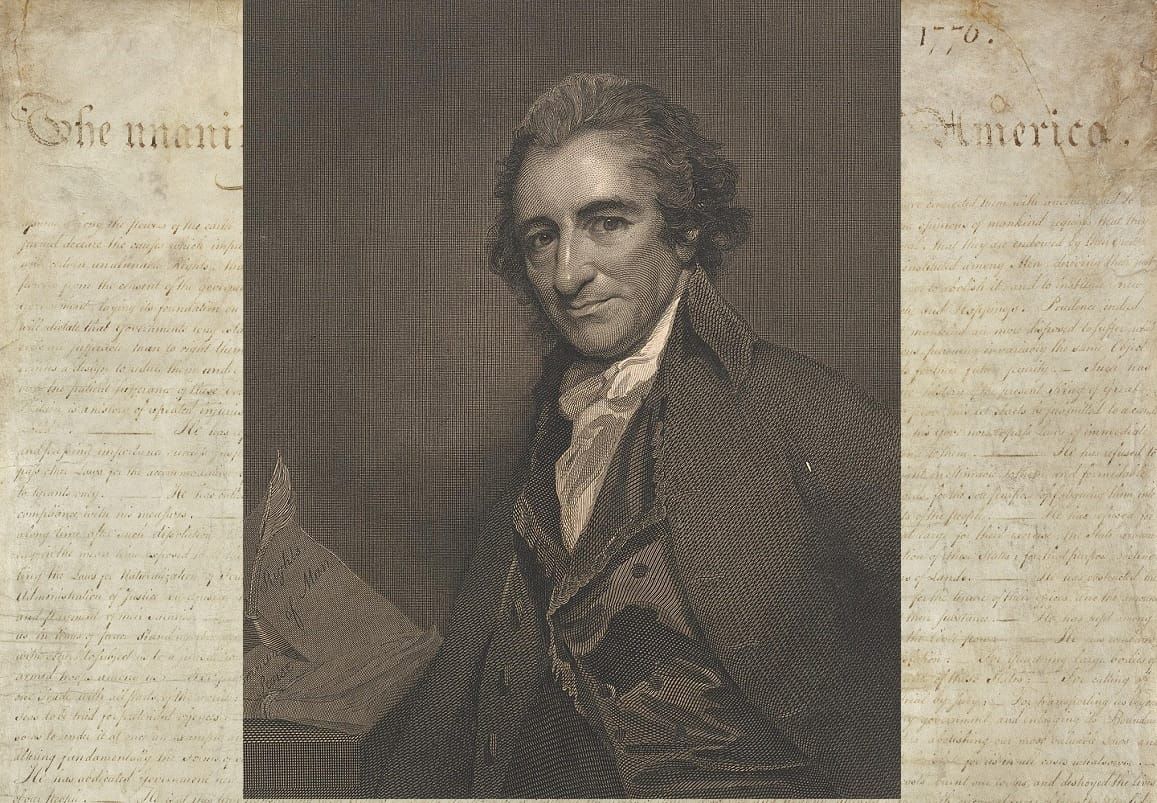
Hoffman argues that three issues have served as the framework of American freethought throughout its existence: antiscriptural, against the authority of the Bible; pro-science as the best hope for human progress; and separationist as regards church and state. The thread that links these issues for him is the continuing legacy of Thomas Paine’s The Age of Reason, published in two parts in 1794 and 1795. In the book, Paine defended deism, which Hoffman describes as “a system of beliefs that affirms the existence of God but denies the intervention of God in the universe by supernatural means”. For Paine, deism was rational and scientific. In contrast, Paine argued against all religions that relied on “the authority of a divinely inspired text, especially Christianity”. Hoffman claims that The Age of Reason was “by far the most widely read deistic work ever produced” and that it had enormous influence, especially in the United States.
Hoffman’s emphasis on Paine and early deists in America is aimed in part at countering interpretations of the Establishment Clause of the First Amendment which insist that the meaning of the Clause was only that the federal government could not favor any one Christian sect over another. Hoffman does not dispute that this meaning was held by many when the clause was adopted, but tries to show that an alternative understanding was also widespread—that Christianity itself was not to be favored and that the federal government was largely to be separate from religion, or at least any organized religion.
Atheism displaces deism over time
Deism as an alternative to Christianity is crucial to Hoffman’s argument because it was both non-supernaturally religious and anti-Christian. Deism explains why George Washington could proclaim the value of religion, in his 1796 Farewell Address, for example, and yet never in his public comments assert the divinity of Christ. It also explains Washington’s references to God as “Providence” or the “Great Spirit”—a god that creates the universe but does not thereafter intervene in the laws of nature is as much a symbol as a reality. Such a deistic God symbolizes the universe as rational, ordered, beneficent and meaningful. Such a god could also be understood as the source of universal human rights, as in the assertion by Thomas Jefferson, another deist, in the Declaration of Independence, that the “Creator” was the source of universal human rights. In contrast to such deistic views, Hoffman asserts that atheism was largely absent from the freethought movement until the 20th century.
Hoffman tracks the gradual change in the American freethought movement from a form of religion—deism—to a much more secular movement, especially in the 20th century. Hoffman illustrates this change by reference to the growth of humanism. The founder of the First Humanist Society of New York, a Unitarian Minister named Charles Francis Potter, described the most essential tenet of humanism as “faith in the supreme value and self-perfectibility of human personality”. In 1933, the first Humanist Manifesto asserted “that the universe is ‘self-existing and not created,’ that the ‘traditional dualism of mind and body must be rejected’ as well as any ‘supernatural or cosmic guarantee of human values’”.
The freethought movement by this point had become predominantly atheistic and materialistic. Paine himself would not have approved of this change. One reason Paine wrote The Age of Reason “was to counter the atheistic tendencies” of the French revolution. In addition, as Hoffman also points out, Paine specifically argued against materialism: “the rising element of materialism within dechristianization that Paine found troubling”. Paine was troubled because he thought that human rights were cosmically, though not supernaturally, guaranteed. In contrast, materialism has no ground for something like human rights. Despite his efforts, Paine’s worry that deism “would be hijacked” by atheism and materialism eventually came to pass in the freethought movement. And, as we know today, the influence of atheism and materialism in organized American secularism has only increased in the 100 years since humanism assumed an organizational form.
Promoting separation of church and state
Hoffman tracks a parallel change over the course of the 20th century, in which the freethought movement came to embrace a legal/constitutional strategy to promote the separation of church and state in the courts. Hoffman’s decision to end the book with the McCollum case in 1948 prevents him from assessing this strategy. But he mentions that the strategy succeeded in the 1960s and 1970s in, for example, removing prayer and Bible reading from the public schools and limiting public funding of private religious schools, but also notes that since the 1970s, a lot of that case law has been superseded. The U.S. Supreme Court has in recent years not only upheld public funding of religious schools through voucher programs and tax deductions against Establishment Clause challenges, but has now required such subsidies pursuant to the nondiscrimination aspect of the Free Exercise Clause of the First Amendment.
These two trends—toward atheism and materialism, on the one hand, and legal failure, on the other—are related. In its various aspects, secularism in America never became a mass movement. Indeed, it has made no real effort to become a mass movement. Instead, it pursues separation of church and state mostly through the courts. In contrast, the civil rights and the gun rights movements engaged in mass organizing at the same time that they pursued litigation strategies. Given how much the percentage of non-religiously affiliated Americans has grown in recent years—estimated currently at between 25% and 30% of American adults—it should be possible to build a mass secular movement.
The problem is that an atheistic and materialistic freethought movement has little to offer to most people. Although estimates are notoriously unreliable, it seems clear that atheists and agnostics make up only a small portion of the nones. Most people are probably closer to beliefs like Paine’s deism than anything else. That’s not supernatural religion, but it’s also not materialism. In order to attract strong popular support, there must be more to secularism than asserting that we choose our own values.
What happened to our deist roots?
The humanist turn in American freethought was never persuasive. Do we have any more reason to believe in the “self-perfectibility” of human beings today than religious people had to believe in original sin? People are people. They are not going to be all good or all bad.
What does the “self-existing” universe mean in light of the Big Bang? The universe did not exist before the Big Bang. Neither did the laws of nature.
If the traditional dualism of mind and body is to be rejected, why should we not choose mind rather than matter as primary? Certainly many physicists today see quantum reality as mind-like. At the heart of the universe, at the most foundational level, there is nothing matter-like. There are no physical particles. That recognition should make us idealists rather than materialists.
And as for human values, why should we think of them as orphans or arbitrary and not linked to the very nature of the universe? After all, we evolved in this universe to be the way we are. So, in some sense, our nature must be consonant with it.
At the very least, all this should be the ground of debate today in American freethought. Instead, materialist assumptions serve largely as irrefutable backdrop to reflexive opposition to anything that smells like religion.
It may be that this need for intellectual change is dawning on secular organizations. The Freedom From Religion foundation, which sees itself as very much a part of Hoffman’s freethought movement, has recently been running quite effective Fourth of July radio ads touting rights and “enlightenment values” at the founding. Of course, those values included separation of church and state and reliance on reason and science. But those enlightenment values also included universal human rights grounded in the nature of the universe, as the Declaration of Independence asserted.
The American freethought movement may be in the process of reconsidering its fundamental philosophical commitments. Maybe American freethought will at last return to its deist roots. That might lead to a mass American freethought movement for the first time.




0 Comments