The Pittsburgh Jewish Chronicle asked five Pittsburgh voices to write their thoughts on America at 250. Here are mine.
Pittsburgh Jewish Chronicle
America at 250 Guest columnist
America, happy 250th birthday
A healthy constitutional democracy operates on consensus.
By Bruce Ledewitz July 1, 2026, 9:02 am
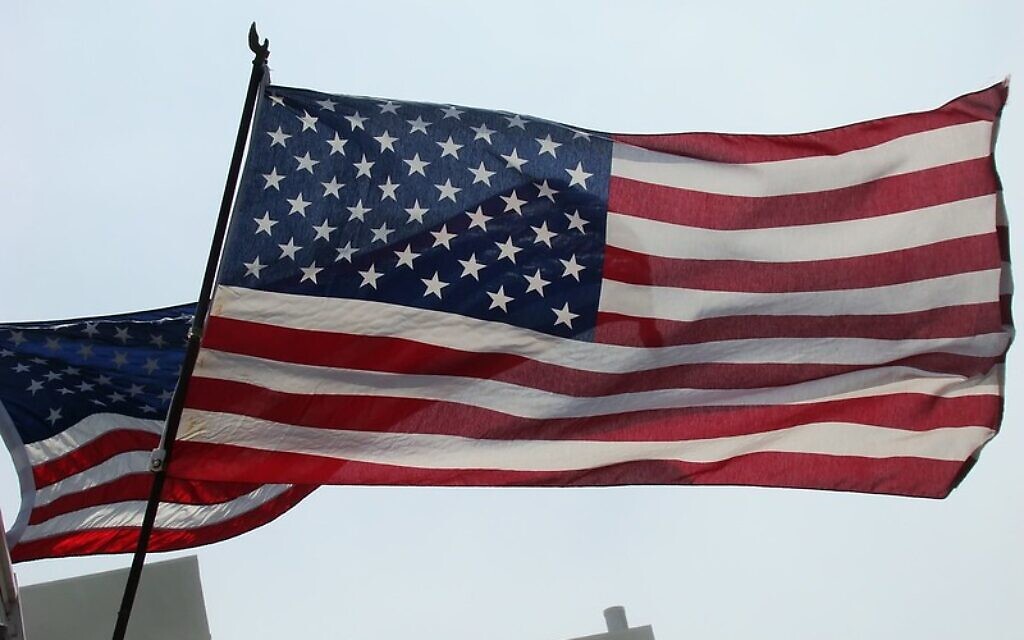
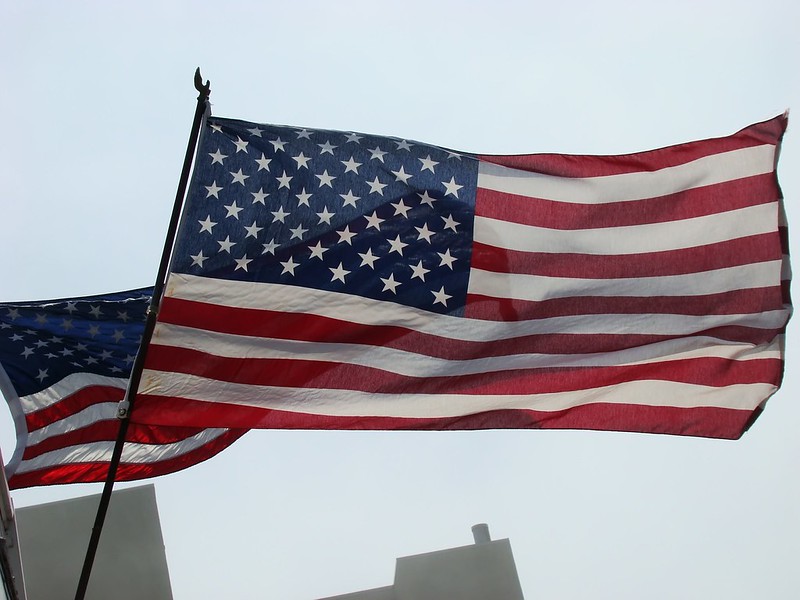
American Flag (photo by Eric Lynch, courtesy of flickr.com)
Many people, on both sides of the political divide, feel that America’s experiment in constitutional democracy is unravelling. If we want to sustain it, we have to understand what we are in danger of losing. We have to ask: What is the foundation of our political system?
The first appeal of the Declaration of Independence, whose 250th anniversary we mark this July 4, was to truth: “We hold these truths to be self-evident.” Not to God, or equality, or rights, but to truth.
Before any political commitments can be advocated, there must first be a societal consensus that truth is real and that reason and open debate are the appropriate means to seek it.
That is why the most important elements of constitutional democracy are not judicial review, or the separation of powers, or federalism — as crucial as these things are — but freedom of speech and of the press.
We can see in the world today that there can be elected despots and captive parliaments. But no country with free speech and a free press will ever suffer autocracy.
President Donald Trump is a unique threat to constitutional democracy, not because he abuses executive power — he is hardly the first — but because he lies: about the 2020 election, about climate change, about everything. Time magazine was prescient when it featured the question “Is Truth Dead?” on the cover of its April 3, 2017, issue, in light of Trump’s election.
Constitutional democracy cannot work without a settled cultural consensus that reasoned debate will lead society closer to truth, although, of course, never fully attaining it. If you believe that it is useless to discuss matters with your political opponents — if for example, you have never had a serious conversation with someone who voted for Donald Trump — then you are part of the threat to American constitutional democracy.
And, of course, the same thing goes for all those Trump supporters who refuse to engage their liberal and progressive opponents.
When elected officials refuse to be interviewed by media outlets they oppose — whether it is the Pittsburgh Jewish Chronicle or FOX News — they undermine our democracy. When they cancel town halls with constituents or skip rallies they once would have attended out of fear of voter backlash, they proclaim their lack of faith in debate as the path to truth.
The current lack of faith in the power of reasoned debate has reduced American democracy to mere power-seeking, rather than truth-seeking. Political consultants will now tell you that the only way to win an election in America is to turn out your base to a higher degree than the base of your opponent turns out. The goal is not persuasion but to attain 50% + 1. Winning is everything.
A healthy constitutional democracy does not operate that way. It operates on consensus.
The current lack of faith in truth has convinced many people that free speech is not worth its cost. And, clearly, there are costs to free speech.
Antisemitism in particular has always utilized free speech to spread its hateful message. Many people are familiar with the Skokie controversy from the late 1970s in which the ACLU waged a successful legal battle to enable neo-Nazis to stage a march in a Chicago suburb that was home to a substantial number of Holocaust survivors. As a result, the ACLU lost thousands of members. In the end, there was no march.
This association with antisemitism has caused some people to lose faith in the principle of free speech. But efforts to suppress speech do not eliminate hateful ideas. One can easily see this with regard to Holocaust denial. In much of Europe, Holocaust denial is a crime. In America, such denial is protected speech. But this has not led to the erasure of such denial in Europe; nor to its spread in the United States.
The focus on anti-Israel rhetoric has obscured the true nature of threats to Jewish students on college campuses in recent years. In the period following the Hamas attack on Israel, Jewish students were confronted with large demonstrations chanting of pro-Palestinian slogans, such as “Palestine shall be free from the river to the sea.” Of course, such “freedom” would necessarily entail the expulsion or elimination of millions of Jews.
There were many calls for the suppression of such speech. Pennsylvania Supreme Court Justice David Wecht recently pointed to the Democratic Party’s tolerance of such chants as part of his reason for leaving the Democratic Party and registering as a political independent.
But not only are these expressions protected by the First Amendment, as well as by the Pennsylvania Constitution; they had nothing to do with the plight of Jewish students on college campuses. Jewish students were not threatened by protected speech. They were faced with assaults and harassment. Rocks were thrown through the windows of Jewish organizations. Large swaths of campuses were essentially off-limits to anyone wearing a kippah. College administrators allowed a total breakdown of campus security and failed to protect the rights of a substantial group of students to function normally.
This breakdown in security had nothing to do with speech. It’s not freedom of speech when a person blocks my path on a sidewalk, screams in my face and physically pushes me. All that is a crime and it was a disgrace that timid college administrators failed to prevent it.
That failure of college security was used by the Trump administration as a pretext for pressuring universities to limit speech, while simultaneously threatening foreign students with deportation for their protected speech. These government actions just compounded the wrong done to Jewish students by characterizing them as the reason for a crackdown on speech.
On America’s 250th birthday, speech and debate are still on firm legal ground. The courts have time and again resisted efforts to limit the constitutional protections of unpopular speakers. But courts can only do so much. Constitutional democracy rests on a societal faith that truth is the goal and free speech the necessary path to that goal. Free speech is something to be celebrated, not just tolerated.
If we keep to that faith, America may one day celebrate its 500th anniversary as the same country we know and love today. Without it, I doubt there will be many future American birthdays to celebrate. PJC
Bruce Ledewitz is professor of law emeritus at the Thomas R. Kline School of Law of Duquesne University. The views expressed in this article do not reflect those of Duquesne University.


0 Comments