
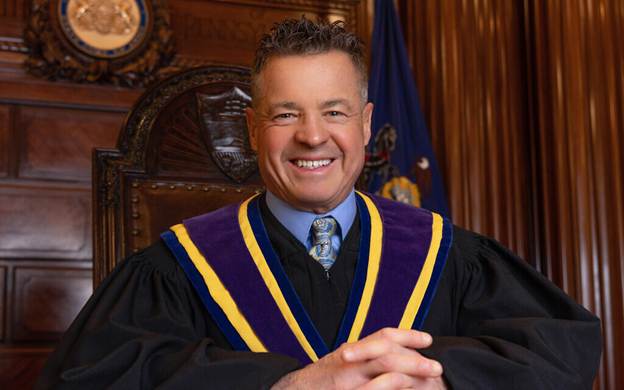
Now that the Pittsburgh Post-Gazette does not publish opinion pieces, I will sometimes post comments here, in my Hallowed Secularism blog. Fortunately, in this instance, the Pittsburgh Jewish Chronicle published my thoughts on Justice David Wecht’s public announcement of his change of party registration. See below.
Opinion Guest columnist
Did Justice Wecht issue an improper public statement?
Supreme Court justice issued statement when leaving the Democratic party
By Bruce Ledewitz June 2, 2026, 9:41 am
Recent years have witnessed several instances of judges rendering inappropriate comments about political events. In 2016, U.S Supreme Court Justice Ruth Ginsburg apologized for critical comments she voiced about Donald Trump, who was then a presidential candidate.
More recently, in April, Justice Clarence Thomas publicly issued a blistering critique of progressivism. While Thomas did not name the Democratic Party, the implication in the current political context was clear.
Then, in early May, Pennsylvania Supreme Court Justice David Wecht made a public announcement that he was changing his voting registration from Democratic to independent because “the Democratic Party has changed. … Nazi tattoos, jihadist chants, intimidation and attacks at synagogues, and other hateful anti-Jewish invective and actions are minimized, ignored or even coddled.”
Even if the charge is true, was Wecht’s public statement proper for a sitting judge?
The rules of judicial conduct, as well as the First Amendment, generally permit judges to make statements about issues of public concern, especially when they involve matters that affect the judiciary.
On the other hand, Rule 4.1 of the PA Code of Judicial Conduct specifically prohibits a judge from engaging “in any political activity on behalf of a political organization or candidate for public office … . ” This would appear to bring Wecht right up to the line of a judicial ethics violation. His statement certainly benefited the Republican Party, but Wecht did not issue his statement “on behalf of” the Republican Party.
Wecht felt that, if he was going to change his registration, he had no choice but to issue a public statement. As he later put it: “When I was elected, I was registered as a Democrat. I am not registered as a Democrat. We live in an elected judicial system, and the voters are entitled to know that.”
Wecht’s argument is reasonable, but it raises another troubling issue. If the people of Pennsylvania were entitled to know why Wecht was changing his party registration, then this was also the kind of information the voters were entitled to know before the November 2025 retention election, when Wecht was returned to the court.
Although nominally non-partisan, the 2025 retention election represented a determined partisan effort by both Republicans and Democrats to gain control of the Pennsylvania Supreme Court. As America’s key swing state, this is the court that will decide any Pennsylvania election law issues affecting the 2028 presidential election. Three Democrats — Wecht, along with Christine Donohue and Kevin Dougherty — were candidates for retention, which both parties assumed would determine the partisan composition of the seven-member court. Both the Republican and Democratic parties spent large sums of money to influence the outcome of that election.
That was when the voters needed to know of Wecht’s change of party registration. Democratic Party voters might not have wanted to retain an independent. Republican voters might have reconsidered their opposition to Wecht’s retention.
Wecht did not suddenly decide in May that antisemitism in the Democratic Party is a problem. In 2019, Wecht referred to the Democratic Party response to the Pittsburgh synagogue shooting as “disgraceful” and “timid.”
One could look at Wecht’s public announcement a mere six months after the retention election as political opportunism — a kind of bait and switch in which Wecht benefited from his connection to the Democratic Party to gain retention and only then changed his party registration and voiced his criticisms.
However, there is another possible explanation for the timing of Wecht’s announcement. Wecht may only recently have concluded that the party crossed a line that made it impossible for him to remain a Democrat.
There is a hint in his public statement that this is what happened. Wecht’s reference to “Nazi tattoos” tolerated by the Democratic Party was universally understood, as Wecht must have known it would be, as a reference to the Senate candidacy in Maine of Graham Platner, who, in October, revealed he’d gotten a tattoo of a Nazi symbol while serving in the U.S. military in Croatia. Platner denied knowledge of the symbol’s Nazi connection.
Even though Wecht has no judicial connection to the state of Maine, he certainly should not be telling people to oppose a candidate for political office. That is the very mistake that Ginsburg had to apologize for. If Wecht was so incensed that he made the reference anyway, Platner may have been the last straw. That would mean Wecht did not decide to leave the Democratic Party until the retention election was over or nearly over.
Wecht’s public announcement of his party registration change also raises the issue of his future recusal in political cases. Wecht criticized the Democratic Party specifically, including the damning accusation that the party ignores “attacks at synagogues.” If Wecht had said the same thing about an individual, he would certainly be expected to recuse himself in any case involving that person.
Wecht raised the recusal issue in a later interview about his announcement: “if anybody has any problem, they can always make a motion for recusal.’”
Wecht was being coy in this comment. He could be confident that the Democratic Party would never move for his recusal because, despite Wecht’s criticisms, Democrats would feel that Wecht would retain the same views on election law issues that he had previously held. In the past, those views have tended to favor Democratic Party arguments in court about expanding voting options.
But the accusation of bias in recusal is a double-edged sword. A party in court may move for recusal on the ground that a judge has shown bias against it. However, opposing counsel may also move for recusal, on the ground that a judge who might be viewed as biased against a party would bend over backward to favor that party in order to show there is no bias.
In other words, although Wecht was criticizing the Democratic Party, it could in the future be the Republican Party that successfully moves for his recusal in political and election law cases.
Recusal protects the integrity of the justice system. But it is not an optimal solution. The people of Pennsylvania elected, and then retained, David Wecht as a justice on the Pennsylvania Supreme Court. The people want, and have a right to, his judgment. They expect him not to engage in conduct that might force his recusal in important cases. Wecht should have thought of that before issuing his public statement. Even if he was right, he was not prudent.
Bruce Ledewitz is professor of law emeritus at the Thomas R. Kline School of Law of Duquesne University.





0 Comments