
My column today in OnlySky.
Indonesia models a different kind of secularism, premised on religious diversity and coexistence.

01 Jun 2026
My wife, Patt, and I just returned from a life-altering visit to Indonesia. I would never have believed that a thoroughly religious country could be so tolerant and welcoming. In Indonesia, religion fosters open inquiry into the meaning of life and, at the same time, serves as a protective glue binding people to each other, thus promoting harmony. While we were there, we learned that Indonesia had recently been ranked number one in a worldwide survey by Harvard’s T.H. Chan School of Public Health that attempted to measure aspects of human flourishing.
Of course, our experience raised the question of whether Indonesia could provide lessons for a fractured and anxious America. Though the conditions in America are very different from those in Indonesia, my answer is at least maybe.
I have to add a few caveats. I’m not pretending to know Indonesia after spending twelve days there. Tourists never get to know a place as well as they think they do. They see and talk to representatives of a thin slice of a nation’s culture. For example, Indonesia is the world’s most populous Muslim country, but Muslims are underrepresented in the tourist industry.
In addition, tourists can only spend time in a small part of any country. Indonesia contains 17,000 islands. Patt and I visited five: Java, Flores, Padar, Komodo and Bali.
And, despite current conditions of harmony, Indonesia has experienced tremendous violence in its past. In 1965, after a failed coup, the army launched a massive retaliatory campaign in which it is estimated that a million people may have been killed—80,000 in Bali alone. The Suharto military dictatorship followed, for thirty-two years. The current President, Prabowo Subianto, is a former special forces commander implicated in human rights abuses, and in late 2025 the government posthumously named Suharto a national hero.
There have also been terror attacks. The most notorious attack occurred in 2002 in Bali, carried out by the militant group Jemaah Islamiyah. More than two hundred people died, and hundreds more were injured.
But these caveats do not change the essence of what we experienced. In Java, not far from the current capital of Jakarta, and thus fairly representative of Indonesia generally, we watched hundreds of school children, and thousands of Indonesian citizens, visiting ancient Buddhist and Hindu temples, celebrating Indonesia’s rich religious history.
Living side by side in harmony
To put this in perspective, in Afghanistan, the Taliban blew up statutes of the Buddha. In Indonesia, Muslims, Hindus and Buddhists live in harmony and learn from each other.
In many Muslim countries, conversion from Islam to another religion is deemed criminal, and that is assuming the accused lives long enough to be tried. In contrast, Indonesia readily accepts religious conversions. We were told that at the age of 17, Indonesians are free to choose their religion. There are even formal ceremonies of conversion, which are needed because Indonesia essentially bans interfaith marriage. In 2021, Sukmawati Sukarnoputri, the daughter of Indonesia’s founding President Sukarno, formally renounced Islam and returned to Hinduism on her 70th birthday.
In similar fashion, although Bali is majority Hindu, there is apparently zero interest in the nationalist and exclusivist version of Hinduism promoted by Prime Minister Narendra Modi’s party in India.
We also noticed that Indonesians genuinely like each other, despite their numerous religious, ethnic and geographic differences. This was shown to us not only by observing everyday encounters, but by the absence of blaring car horns despite the almost impassible driving conditions throughout the country.
What allows this religiously, ethnically, and geographically diverse nation to work so well? The Indonesians I asked could not really answer that question beyond telling me that Indonesians value harmony. But here are some observations that may be relevant.
Pancasila
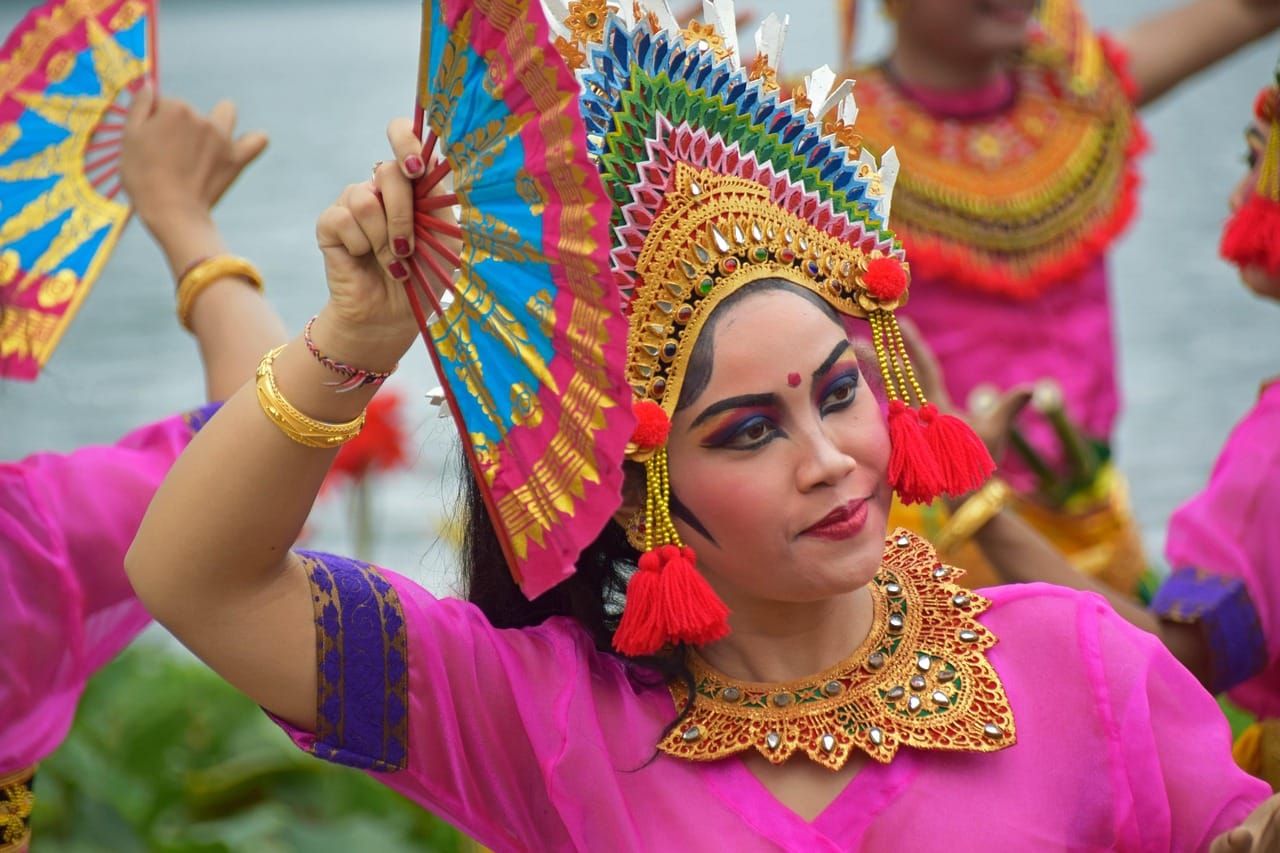
First, in Indonesia, religion itself promotes harmony. Indonesia is an exceedingly religious country. On Java, the Muslim call to prayer is beautifully ubiquitous. I awoke to it at 4:30 most mornings. On predominantly Hindu Bali, there are temples in every village and offerings in front of nearly every house. There is even a Confucian temple for the Chinese population.
On the domestic airline, there is an “Invocation Card” next to the safety instructions, containing a prayer for the journey for each of the five officially recognized faiths: Islam, Protestant, Catholic, Hindu, Buddhism and Confucianism.
An American might think that the followers of each of these religions would constantly clash with each other. But that is not the case. We watched as non-Muslim musicians refrained from playing music during the call to prayer as a sign of respect. That is, religion is taken so seriously that no one would demean another person’s religious practice.
This religious orientation is quite monotheistic, despite suggestions that Hinduism celebrates many gods or that Buddhism is not really theistic at all. The national ideology, called Pancasila (“the five principles”), has as its first principle, “Belief in Almighty God.” But this is a peculiar kind of monotheism. We were told that the Hindu name for God translates to “destiny.” This is not a conception of an active God interfering in human events. This emphasis on the impersonality of the divine may remove the temptation to “prove” that one religion is better than another. It felt secular in a way. Destiny affects everyone.
In fact, there is not much emphasis on religious creeds and content at all. We encountered a lot of playful ideas about the meaning of reincarnation, for example. The hotels in Java carry only beef bacon, since pork is forbidden to Muslims, but there is no similar compunction against alcoholic beverages. On Bali, the Hindu majority does not prevent people from eating hamburgers. In fact, on Bali we met incredulity at the practice, common in many parts of India, of cows roaming freely. In Indonesia, religion seems for many to function as a matter of customs and ceremonies, not beliefs. This also promotes religious harmony and even religious sharing. Gift giving at Christmas time is common although Christianity is not a dominant religion.
Even what looks to us like religious coercion does not seem to feel that way to Indonesians. Every Indonesian is required to carry an ID card that mandates a religious category for the cardholder. The person’s choice of religion can only be among Islam, Protestantism, Catholicism, Hinduism, Buddhism and Confucianism. When we asked about people without any religious commitment—the equivalent of the American “nones”—we were met with blank stares. This may be related to the absence of creedal content. With such loose religious content, why would anyone refuse to provide some kind of affiliation? An Indonesian might say, “Oh, everyone has some religion.” It would not be of ultimate significance which religion a person identifies with.
Religion in Indonesia has apparently functioned as a binding force, rather than one of separation, for a very long time. Indonesia has a history of religious fusion. On several occasions, we were told the story of the 8th-century merger through marriage of a Buddhist kingdom and a Hindu kingdom, which led to the building of several Buddhist temples on a large Hindu temple site.
Politics is not a preoccupation
The second aspect of life that struck us was that the central government seems very far away. There is obviously a strong tendency toward what we call federalism in the American context. In 2018, Bali created a gigantic sculpture of the Hindu god Vishnu riding the mythical bird Garuda. That is not something that would be welcome in other parts of Indonesia but was popular in Hindu Bali.
For years, American conservatives argued that strong state governments would promote a healthy diversity in America. Policies appropriate for California would not be popular in Texas. Indonesia supports that argument.
But maybe the most important difference from America right now is that politics itself is not a preoccupation in Indonesia. We expected to constantly have to justify ourselves as Americans, given President Donald Trump and his policies. Yet the whole matter never really came up, except around other Americans. I’m sure there are strong feelings that were not communicated to us about the war with Iran, for example, but Indonesians generally seem to have other priorities. In fact, Indonesian politics did not really come up, even in terms of the grousing about government that we have often heard in other countries.
Granted, the Indonesian context is not necessarily transferable to America. After all, if you believe Trump is an immediate threat to constitutional government, you don’t have the luxury of downplaying politics in your consciousness.
But there are some lessons that Americans could learn. The Indonesian experience shows that religion is not a monolithic phenomenon. Religion there is just not the divisive force that it is in America. Nor is religion there primarily about the truth of religious claims. Religion is more of a cultural phenomenon and it is a crucial aspect of Indonesia’s healthy culture.
That does not mean that American nonbelievers should go back to church, but it does suggest that reflexive opposition to everything religious, and the accompanying feeling that religion is superstitious nonsense, are not justified.
This appreciation of religion could apply to the current drive in some Republican states to bring Christianity back to a position of cultural dominance, including putting the Ten Commandments in school classrooms. Such efforts may well be unconstitutional, even if the U.S. Supreme Court rules otherwise. But, in thinking about how someone in Indonesia might view such efforts, the response might be more inclusion rather than trying to exclude everything religious. Think of all the foundational texts that might be included in such classroom displays. Since the proponents of the Ten Commandments do not, and legally cannot, admit they are trying to bring back Christianity, they might even be forced to acquiesce to some additions. That is essentially what happened in the two Ten Commandments cases that split the Supreme Court in 2005.
More generally, Patt and I came back from Indonesia determined to live our lives in greater harmony with life around us, human and otherwise. In particular, we were impressed with the daily offerings we saw everywhere in Bali. These offerings were universally described to us as daily expressions of gratitude.
If you asked to whom these offerings were actually addressed, you did not get a clear answer. And maybe that is the whole secret of Indonesia. Religion there offers concrete ways to express gratitude and joy. Americans certainly have as much to be thankful for as do Indonesians. Even today. Maybe we need some secular rituals that would allow us to contemplate and reflect that gratitude. And those expressions might bring us greater joy.




0 Comments